Deck vs. Patio vs. Pavilion vs. 3-Season Room: Which Outdoor Living Space Is Right for Your Worcester County Home?
/By CORE Remodeling Services - Your Outdoor Living Transformation | 2 of 4-Part Series
When Worcester County homeowners decide they want to do something with their outdoor space, the first question is almost always the same: What should we actually build?
Deck? Patio? Pavilion? 3-season room? Each one sounds appealing. Each one costs something different.
And choosing the wrong one — or building something without fully understanding what you're getting — is one of the most common sources of remodeling regret we hear about.
So let's settle this clearly. Here's how each outdoor living option is different, who it's best for, and what you should be thinking about before you decide.
Option 1: The Deck
What it is: A raised or grade-level platform structure, typically made of pressure-treated wood, composite decking (like Trex or TimberTech), or PVC, attached to or adjacent to the home.
Best for: Homeowners who want a versatile, open-air outdoor living space that connects directly to the house — usually off a back door, kitchen, or living area.
What you get:
- A dedicated outdoor area for dining, entertaining, and relaxing
- Strong connection between indoor and outdoor living
- Ability to add built-in features like benches, pergolas, railing lighting, and outdoor kitchens
- A structure that adds measurable resale value
What to consider in New England: Decks in Massachusetts need to be built to withstand freeze-thaw cycles, heavy snow loads, and humid summers. Material choice matters enormously here.
Pressure-treated wood is cost-effective but requires ongoing maintenance. Composite decking costs more upfront but is virtually maintenance-free and lasts decades.
In our climate, composite almost always wins over the long run.
Typical project size in Worcester County: 200–600 sq ft
Best fit if: You want open-air outdoor living, your home has a natural exit point to the backyard, and you want a durable structure with strong ROI.
Option 2: The Patio
What it is: A ground-level outdoor surface — typically poured concrete, pavers, or natural stone — that creates a defined outdoor living area.
Best for: Homeowners whose homes sit at or near grade level, who prefer a seamless transition from lawn to living space, or who want a lower-profile outdoor area.
What you get:
- A hard, stable surface for furniture, dining, and entertaining
- Flexibility in shape, size, and material
- Often a lower cost entry point than a full deck structure
- A space that can be enhanced with fire pits, outdoor kitchens, shade sails, and landscaping
What to consider in New England: Freeze-thaw cycles are hard on patios. Concrete can crack.
Paver patios installed with proper drainage and compacted base material hold up significantly better in our climate than slab concrete.
Material quality and proper installation are the difference between a patio that looks great for 20 years and one that's heaving and cracking within five.
Typical project size in Worcester County: 200–800 sq ft
Best fit if: Your home is at grade, you want a natural integration with your yard, or you're looking for a strong value relative to the square footage you're adding.
Option 3: The Pavilion
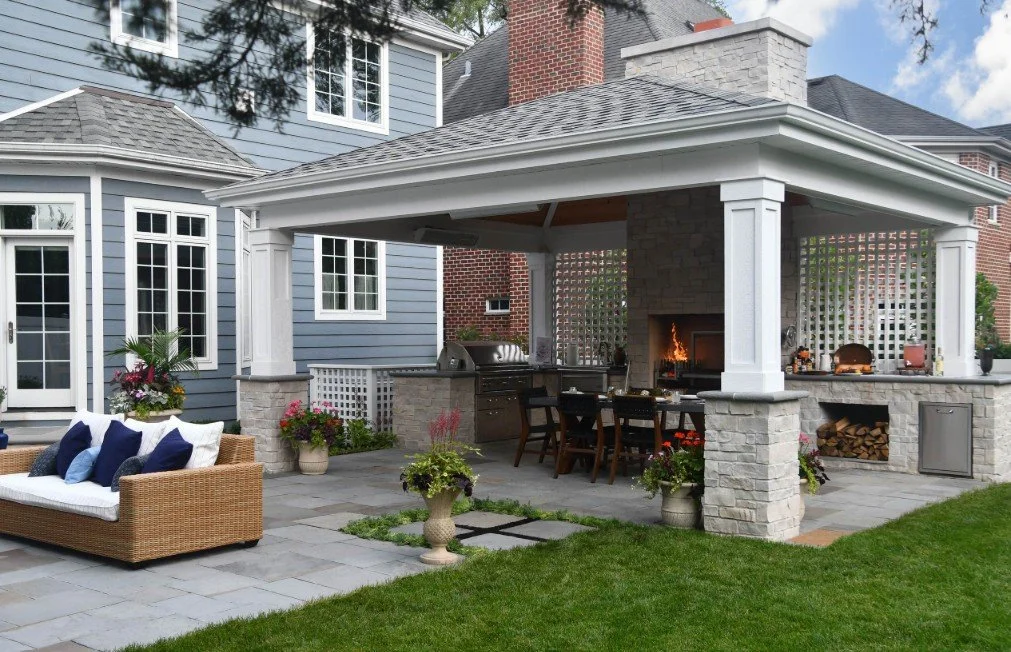
What it is: A freestanding or attached covered outdoor structure — typically a roof supported by posts, open on the sides — that creates a sheltered outdoor living space.
Best for: Homeowners who want to use their outdoor space in all weather, need shade, or want a defined "room" feeling outside without full enclosure.
What you get:
- A fully covered outdoor area that's usable in rain, full sun, and early fall
- The ability to add fans, lighting, heaters, and outdoor AV systems
- A dramatic visual impact on your backyard and your home's curb appeal
- A destination space that elevates how guests experience your home
What to consider in New England: In Worcester County and MetroWest Massachusetts, a pavilion extends your outdoor season meaningfully — but it doesn't replace a fully enclosed space.
You'll still lose functionality in November through April.
That said, a well-built pavilion with outdoor heaters can push the season well into October.
Typical project size in Worcester County: 200–500 sq ft covered area
Best fit if: You want shade and rain protection without enclosing the space, or you want an impressive outdoor destination that works as its own architectural feature.
Option 4: The 3-Season Room
What it is: An enclosed addition to the home — typically built off a deck or patio door — with screened or glass panels that can be opened in warm weather. Not fully insulated for year-round use, but protected from bugs, rain, and mild cold.
Best for: Homeowners who want the feeling of being outside without actually being exposed to the elements — and who want significantly more usable months out of their outdoor space.
What you get:
- A protected, enclosed space usable from April through October in New England
- Elimination of bugs, which is a game-changer for families in wooded or lakeside areas
- A flexible space that can serve as a dining room, lounge, playroom, or home office extension
- More architectural permanence than a deck or patio — this is a real addition
What to consider in New England: A 3-season room is not insulated for winter use — that's the distinction from a 4-season sunroom.
In our climate, you'll get roughly 6–7 months of comfortable use.
The space needs proper ventilation and drainage design to handle New England humidity and rain.
Typical project size in Worcester County: 120–400 sq ft
Best fit if: Bugs are a major issue, you want an enclosed space with a more "room" feel, or you want to meaningfully extend your usable outdoor season.
How to Choose: A Simple Framework
| Open Air | Covered | Enclosed | |
|---|---|---|---|
| Deck | ✓ | Optional add-on | No |
| Patio | ✓ | Optional add-on | No |
| Pavilion | Partially | ✓ | No |
| 3-Season Room | No | ✓ | ✓ |
Ask yourself these three questions:
- How much weather protection do I want? If the answer is "a lot," lean toward a pavilion or 3-season room.
- Do bugs drive me inside? If yes, the 3-season room is worth considering seriously.
- What's my budget and timeline? Decks and patios typically have a lower entry cost and faster build timeline. Pavilions and 3-season rooms are larger investments with longer project timelines.
What CORE Recommends
There's no one-size-fits-all answer — and any contractor who tells you otherwise without asking about your home, your family, and how you live isn't doing their job.
At CORE Remodeling Services, our outdoor living planning conversations start with you, not with a product.
We look at your home's architecture, your exit points, your yard's grade, your town's permitting requirements, and your lifestyle before we ever talk about materials or price.
That's the difference between an outdoor space you love and one you tolerate.
Next in the series — Part 3, April 21: What Does an Outdoor Living Project Really Cost in Central MA? (And What Actually Makes It Worth It)