ChatGPT Said My Remodel Would Cost Less — So Why Is My Contractor’s Estimate Higher?
/
More homeowners are using AI tools such as ChatGPT to research remodeling projects before they ever call a contractor.
And we understand why.
You can ask a question like:
“How much should a kitchen remodel cost?”
Within seconds, you have a number.
The problem comes when that number becomes the budget homeowners expect their actual project to cost.
We occasionally speak with homeowners who have already researched construction costs using AI. When we begin discussing realistic pricing for their project, they are surprised—sometimes very surprised—because the number they were given online was significantly lower.
So which number is right?
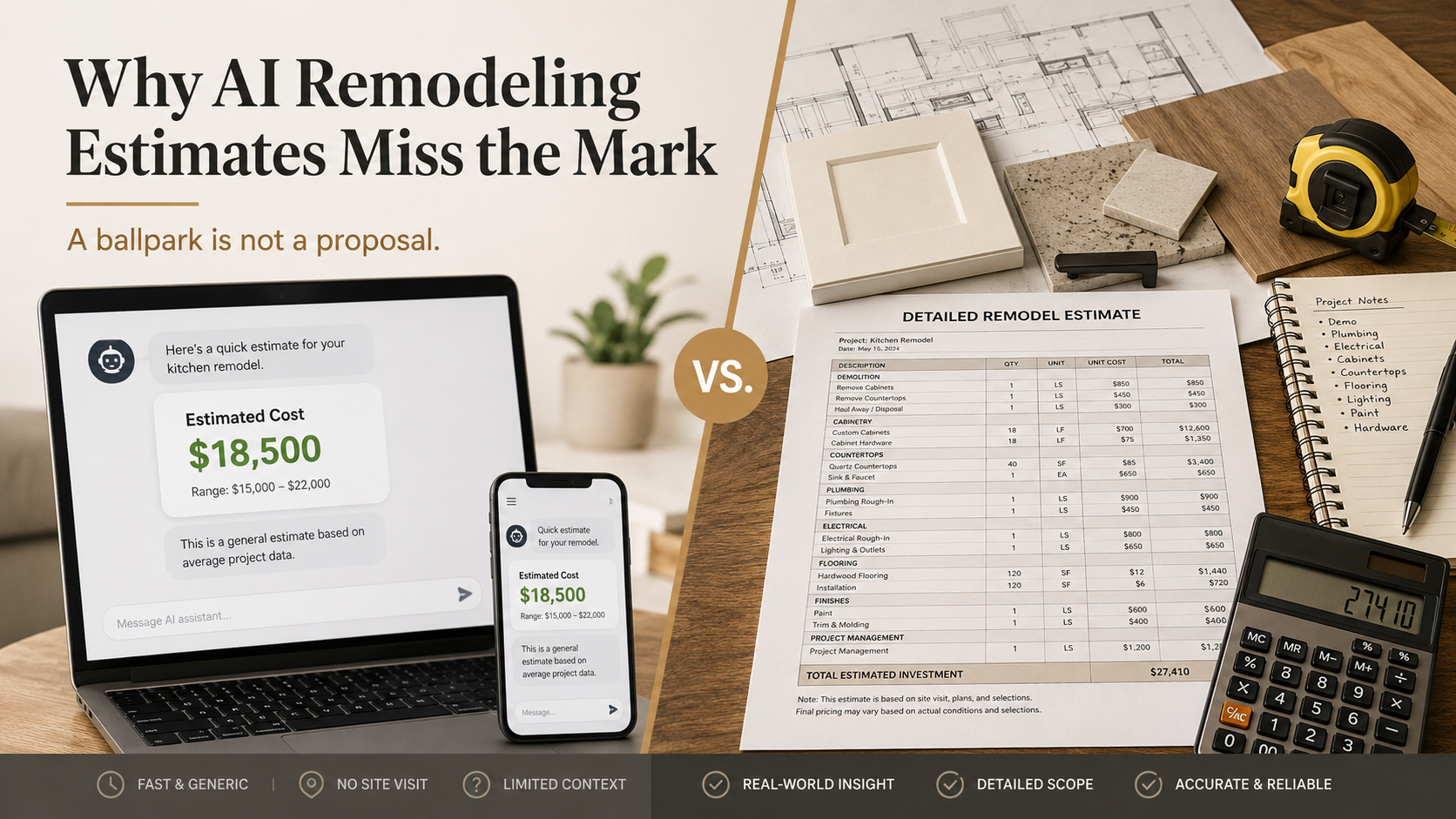
The answer is that an AI-generated price and a professional construction estimate are two very different things.
AI Can Give You a Range. It Cannot See Your House.
Artificial intelligence can be a useful starting point for understanding remodeling terminology, comparing materials, generating questions to ask a contractor, or learning about the construction process.
What it cannot do from a simple question is walk through your home.
AI doesn't automatically know:
The age and condition of your house
What is behind your walls
Your existing plumbing and electrical systems
Structural conditions
Access to the project area
Whether walls are load-bearing
Whether mechanical systems need to be relocated
Local building-code requirements
Permit requirements
Your exact product selections
The quality level you expect
The amount of design and project management your project requires
All of those things can materially affect the cost of a remodel.
Two kitchens that are both 250 square feet can have dramatically different construction costs.
Where Do AI Construction Prices Come From?
When an AI tool provides a remodeling cost, it may be drawing from broad information such as national averages, published cost guides, articles, historical information, and other generalized sources.
That can be helpful for understanding whether a project is more likely to cost $20,000 or $200,000.
But construction is extremely local.
Labor rates in one part of the country may be very different from labor rates in Massachusetts. Material costs change. Building requirements vary by municipality. The types of homes being remodeled are different.
A national average cannot account for all of that.
And an average is exactly that—an average.
It is not a proposal to remodel your home.
The Scope of Work Is Usually the Missing Piece
This is probably the biggest reason online remodeling numbers can be misleading.
Ask:
“How much does a bathroom remodel cost?”
What bathroom?
Are we replacing fixtures in their existing locations?
Or are we:
Removing everything to the framing?
Relocating plumbing?
Installing a custom tile shower?
Adding radiant heat?
Replacing electrical?
Installing custom cabinetry?
Changing windows?
Repairing framing?
Improving ventilation?
Bringing existing conditions up to current code?
Both projects can technically be called a “bathroom remodel.”
Their costs will not be remotely the same.
Without a clearly defined scope of work, almost any construction price is just a guess.
Product Selections Matter More Than People Realize
A kitchen can include a $500 faucet or a $2,000 faucet.
Cabinetry can vary tremendously in price.
So can:
Countertops
Appliances
Tile
Plumbing fixtures
Lighting
Flooring
Hardware
Windows and doors
Even seemingly small selections can add thousands of dollars when you consider the entire project.
That is why responsible estimating requires more than knowing the size of the room.
The estimator needs to understand what is actually being installed.
Construction Costs Include More Than Materials and Labor
This is another area where quick online estimates can fall short.
A professionally managed remodeling project includes much more than the carpenter standing in your kitchen.
Depending on the project, costs may include:
Design and planning
Architectural or engineering services
Permitting
Demolition
Disposal
Site protection
Project management
Trade coordination
Inspections
Material handling
Deliveries
Specialty subcontractors
Temporary facilities or protection
Cleanup
Warranty obligations
Business insurance and operating costs
A professional remodeling company has to account for what it actually takes to successfully manage a project from beginning to end.
Remodeling Is Different From New Construction
Existing homes come with surprises.
Once walls and ceilings are opened, contractors may discover conditions that were impossible to fully evaluate beforehand.
Older homes can present additional challenges such as outdated wiring, old plumbing, structural modifications made by previous owners, inadequate insulation, water damage, or work that does not meet today's building standards.
That doesn't mean every remodeling project will uncover a major issue.
It does mean that estimating renovations requires experience with existing homes—not simply multiplying square footage by an online price.
Why Local Experience Matters
A contractor who regularly works in your area understands things an online calculator may not.
That includes local:
Labor costs
Trade availability
Material pricing
Permit requirements
Inspection processes
Building practices
Housing stock
A remodeling company that has completed projects similar to yours also has real historical job-cost information.
That information is far more valuable than a generalized national average when determining what it may actually take to build your project.
Why We Don't Want to Give You a False Number Either
Homeowners naturally want to know what something will cost.
We understand that.
But providing an unrealistically low number just to make a project sound affordable doesn't help anyone.
If the actual project ultimately costs substantially more, the homeowner feels misled and everyone has wasted time.
At CORE Remodeling Services, our goal is to help homeowners establish realistic expectations as early in the process as possible.
As the project becomes more clearly defined through design, plans, scope, selections, and estimating, the pricing becomes more accurate.
That process takes more work than typing a question into a search box, but there is a reason for it.
So Should You Ask AI About Remodeling Costs?
Absolutely.
Just use the information for what it is.
AI can be useful for:
Learning about remodeling
Developing questions for your contractor
Comparing materials
Exploring design ideas
Understanding construction terminology
Creating preliminary wish lists
Identifying decisions you may need to make
Where we would be cautious is treating an AI-generated price as a construction estimate.
Instead of asking only:
“What should my remodel cost?”
Try asking:
“What factors could affect the cost of my remodel, and what questions should I ask a local design-build contractor before establishing my budget?”
That question will probably prepare you much better for your first conversation with a remodeling professional.
A Ballpark Is Not a Proposal
Early budgeting is an important part of remodeling.
A realistic investment range can help determine whether it makes sense to continue developing a project.
But until the design, scope, plans, specifications, and selections are developed enough to estimate the work, nobody truly knows what the final project will cost.
Not Google.
Not an online cost calculator.
Not AI.
And not a contractor who has only heard a two-sentence description of the project.
A real construction estimate is built around a real scope of work.
The Better Question
Instead of focusing entirely on:
“What did the internet say this should cost?”
Ask:
“What exactly is included in this price?”
That is where meaningful comparisons begin.
One contractor's $100,000 project and another contractor's $150,000 project may not actually be the same project at all.
Understanding the scope, specifications, allowances, services, warranty, and construction process behind the number is every bit as important as the number itself.
The Bottom Line
AI is an incredible research tool, and it will continue to become part of how homeowners plan remodeling projects.
But it should be the beginning of the conversation—not the final word on construction cost.
Your home, your selections, your scope of work, your location, and your expectations are unique.
And when you're making a significant investment in your home, the most useful number isn't the fastest one you can get.
It's the one based on what you're actually planning to build.