Is Taj Mahal Quartzite a Fad? How to Choose a Countertop You Won’t Regret
/
When you start shopping for kitchen countertops, it does not take long before you begin seeing the same names over and over again.
Right now, one of those names is Taj Mahal quartzite.
It is everywhere—showrooms, Pinterest, Instagram, designer kitchens and remodeling inspiration photos. And when something becomes that popular, it is natural to start wondering:
Am I choosing something timeless, or am I choosing the countertop everyone will associate with the 2020s ten years from now?
It is a fair question, especially when countertops are one of the bigger investments in a kitchen remodel.
First: Is Taj Mahal Quartzite a Fad?
We wouldn't call Taj Mahal quartzite a fad.
It is certainly very popular right now, but popular and trendy do not necessarily mean the same thing as temporary.
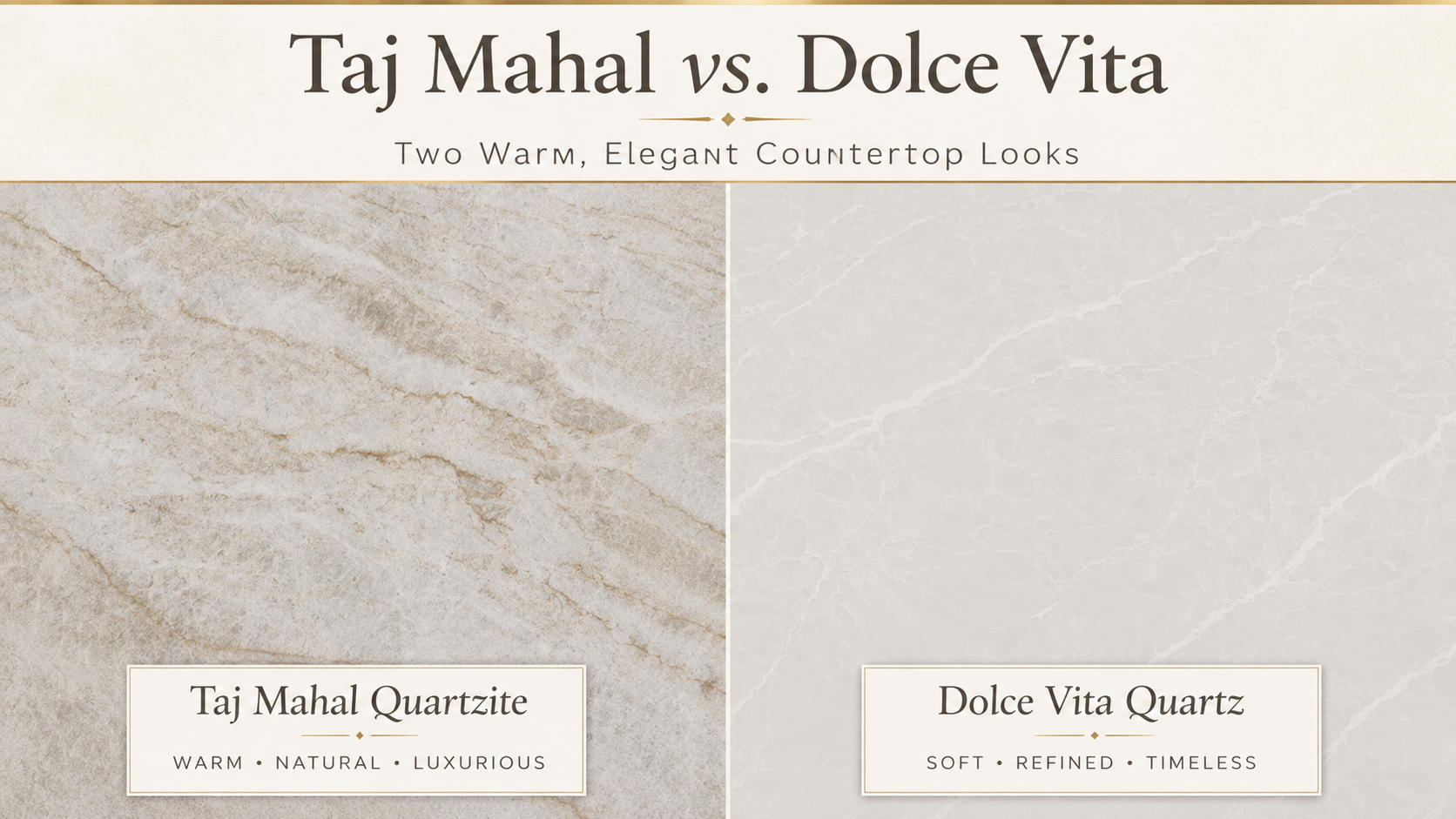
Taj Mahal is a natural quartzite known for its soft cream, ivory and beige coloring with subtle movement throughout the stone. Those warm neutral tones are part of the reason it works in so many different kitchens.
It can pair beautifully with:
White cabinetry
Warm whites and creams
Natural wood
White oak
Walnut
Greige and taupe
Brass, nickel or black hardware
Traditional, transitional and contemporary cabinetry
That versatility gives it much more staying power than a countertop with a very distinctive color or pattern.
So Why Does Taj Suddenly Feel Like It's Everywhere?
Because it is.
Kitchen design has been moving away from the cool gray and stark white palettes that dominated for years and toward warmer, more natural spaces.
Homeowners still want light kitchens, but many are looking for something softer than a bright white countertop with gray veining.
Taj Mahal fits that shift almost perfectly.
It gives you the lightness people love without necessarily giving you that crisp white-and-gray look we've seen so much of over the last decade.
That is a big reason it has become so popular.
Can Something Be Timeless AND Overused?
Absolutely.
This is where countertop selection gets interesting.
A material itself may have longevity while a particular combination of finishes becomes strongly associated with a certain period.
Think about some of the kitchens we recognize immediately from previous decades. It wasn't necessarily one individual material that dated the room. It was often everything being used together.
Taj Mahal quartzite paired with white oak cabinetry, warm white walls, brass hardware and a full-height matching stone backsplash is beautiful.
But when the exact same combination appears again and again, it can begin to feel more like a design formula.
That doesn't mean you shouldn't use it.
It means your kitchen should still feel like your kitchen, rather than a copy of the kitchen currently dominating your social media feed.
What About Quartz That Has a Softer Background?
This is another direction we're seeing homeowners consider.
Instead of choosing a quartz with a bright solid-white base and dramatic veining, there are more options available with softer backgrounds and lower-contrast movement.
One example is Emerstone's Dolce Vita quartz.
Dolce Vita has a softer background with white veining rather than the traditional white-background/darker-vein combination many homeowners immediately associate with quartz.
Depending on the lighting, cabinetry and surrounding finishes, that type of surface can create a warmer and less stark overall look.
And because it is quartz rather than natural quartzite, it also offers a different ownership experience.
Taj Mahal Quartzite vs. Quartz: They're Not the Same Thing
Although some quartz manufacturers create colors inspired by natural quartzite, natural quartzite and engineered quartz are different materials.
Taj Mahal Quartzite
Because it is natural stone, every slab is unique.
That means you will see natural variation in:
Color
Veining
Movement
Pattern
Mineral deposits
For many homeowners, that uniqueness is exactly the appeal.
Natural quartzite is also known for its durability, but like other natural stones, it generally requires sealing and appropriate care.
Engineered Quartz
Quartz offers more predictability.
The slab you select is generally going to have a more controlled pattern and color, which can make it easier to coordinate cabinetry, flooring, backsplash and paint selections.
Quartz is also nonporous and generally requires less routine maintenance than natural stone.
Neither one is automatically "better."
They are simply different products, and the right choice depends on how you want your kitchen to look—and how you want to live with it.
Don't Choose a Countertop Because of Its Name
This may be the most important advice of all.
Don't choose Taj Mahal simply because everyone is asking for Taj Mahal.
And don't eliminate it simply because everyone is asking for it.
Look at the actual slab.
Natural stone can vary significantly from slab to slab, and even manufactured surfaces can look very different in a showroom than they do inside your home.
Bring your other selections with you whenever possible:
Cabinet door sample
Flooring sample
Backsplash
Paint colors
Hardware finish
Then look at everything together.
A countertop never exists by itself. It is one part of the entire kitchen.
Pay Attention to Undertones
This becomes especially important when you are working with whites, creams, taupes and greiges.
A countertop that looks cream in the showroom could suddenly appear gray next to one cabinet color—or yellow next to another.
Lighting matters too.
Natural daylight, warm LED lighting and cool showroom lighting can make the same slab look surprisingly different.
This is why we encourage homeowners to evaluate the entire palette rather than selecting each finish independently.
If You Love Taj Mahal, Should You Still Use It?
Yes.
If you walk into the stone yard, see a slab of Taj Mahal and genuinely love it, we would not eliminate it because it is popular.
Your kitchen is something you are going to live with every day.
The better question isn't:
"Is everyone else using this?"
It's:
"Will I still love this when the current trend cycle moves on?"
If the answer is yes, that matters much more.
How to Make a Popular Countertop Feel More Personal
If you're worried that your kitchen will look like everyone else's, you don't necessarily need to choose a completely different countertop.
Instead, look at the entire design.
Consider introducing personality through:
Cabinet color or wood species
Backsplash
Lighting
Hardware
Plumbing fixtures
Flooring
Island color
Hood design
Architectural details
A beautiful neutral countertop can actually give you more freedom to change other elements over time.
Our Take
Taj Mahal quartzite isn't going anywhere tomorrow.
Its warm neutral coloring, natural variation and versatility give it qualities that extend beyond one design season.
But there is also nothing wrong with wanting something a little different.
If a quartz such as Dolce Vita gives you the softer background and subtle movement you love without feeling like the countertop you've already seen a hundred times, it deserves consideration too.
The goal of a kitchen remodel isn't to choose the countertop that is getting the most attention today.
It's to create a kitchen that still feels like you years from now.